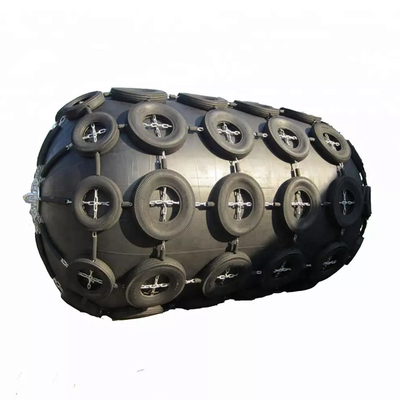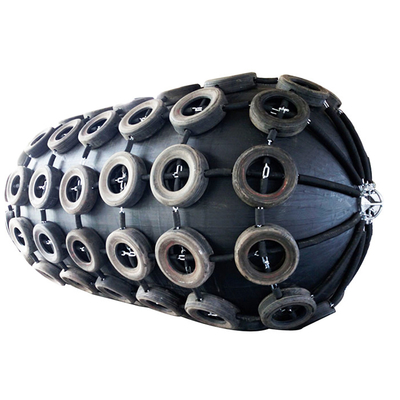
Yokohama Pneumatic Fenders are engineered marine energy absorption systems designed for emergency berthing operations, rapid-response offshore logistics, and temporary maritime infrastructure deployment where conventional fixed fender installations are unavailable or impractical.
The system is constructed using a cylindrical elastomer pressure body reinforced with multiple layers of high-tensile synthetic tire-cord fabric, forming a sealed pneumatic chamber that operates under controlled compressed air pressure to dissipate kinetic berthing energy.
The operational principle is based on progressive pneumatic compression behavior, where internal air pressure increases in response to external impact forces generated during vessel contact under non-standard or emergency docking conditions.
Location: Typhoon Recovery Port, Philippines
Following a major typhoon event in the Philippines, a regional coastal port experienced severe structural damage to its primary berthing infrastructure, resulting in reduced operational capacity and inability to accommodate medium and large displacement cargo vessels required for humanitarian relief logistics.
Hongruntong Marine supplied a set of Yokohama Pneumatic Fenders configured for emergency deployment and temporary port reconstruction support. The system was rapidly installed along improvised berthing zones using available mooring structures and floating support platforms.
During operational deployment, the fenders demonstrated stable energy absorption performance under irregular vessel approach conditions and non-standard docking geometries, effectively mitigating impact forces during repeated cargo vessel arrivals delivering relief supplies.
| Place of Origin | China |
| Brand Name | Yokohama pneumatic fenders |
| Material | Natural Rubber |
| Color | Black |
| Application | In Ports with Extreme Tidal Variations, Ship-to-Ship Lightering Operations, Oil Gas (Typically FSRU), Temporary Berthing |
| Feature | Heat Resistance |
| Temperature | -40℃~300℃ |
| Lead time | 7-14 days |
| Diameter x Length [mm] | 50kPa Performance Data | 80kPa Performance Data | ||||
|---|---|---|---|---|---|---|
| Hull Pressure at GEA / kN/m² | Reaction Force / kN | Energy Absorption / kNm | Hull Pressure at GEA / kN/m² | Reaction Force / kN | Energy Absorption / kNm | |
| 1000 x 1500 | 122 | 182 | 32 | 160 | 239 | 45 |
| 1000 x 2000 | 132 | 257 | 45 | 174 | 338 | 63 |
| 1200 x 2000 | 126 | 297 | 63 | 166 | 390 | 88 |
| 1350 x 2500 | 130 | 427 | 102 | 170 | 561 | 142 |
| 1500 x 3000 | 153 | 579 | 153 | 174 | 761 | 214 |
| 1700 x 3000 | 128 | 639 | 191 | 168 | 840 | 267 |
| 2000 x 3500 | 128 | 875 | 308 | 168 | 1150 | 430 |
| 2500 x 4000 | 137 | 1381 | 663 | 180 | 1815 | 925 |
| 2500 x 5500 | 148 | 2019 | 943 | 195 | 2653 | 1317 |
| 3300 x 4500 | 130 | 1884 | 1175 | 171 | 2476 | 1640 |
| 3300 x 6500 | 146 | 3015 | 1814 | 191 | 3961 | 2532 |
| 3300 x 10600 | 158 | 5257 | 3067 | 208 | 6907 | 4281 |
| 4500 x 9000 | 146 | 5747 | 4752 | 192 | 7551 | 6633 |
* Other sizes can be produced following client's requirements.
Engineered for immediate operational deployment in environments where permanent marine infrastructure is unavailable or damaged, allowing fast inflation and integration into temporary berthing configurations.
The internal pneumatic chamber accommodates unpredictable impact forces and dynamically adjusts internal pressure distribution to stabilize reaction forces under non-standard approach angles.
Formulated for extended temporary deployment under harsh environmental conditions, including debris exposure and contaminated water environments.
Cylindrical floating design enables full operational independence from fixed port infrastructure, providing reliable energy absorption without engineered quay structures.
Yes, the system is specifically designed for emergency deployment in ports with damaged or incomplete infrastructure.
The system can be deployed and activated within a short timeframe depending on inflation setup and mooring availability.
Yes, it is engineered for sustained use under continuous vessel traffic in disaster relief and emergency supply chains.
Yes, the floating design allows full operation in infrastructure-free coastal or offshore environments.
The system supports cargo vessels, supply ships, naval support vessels, and humanitarian logistics ships of varying displacement classes.